No Gas, No Brakes.

Last Friday, Curtis and I drove separately to a wedding rehearsal in southern Michigan. He left a few hours before me in our friend's car, as he was running the A/V for the ceremony and reception so he had to be there early, and I had to finish my work day before I could head out.

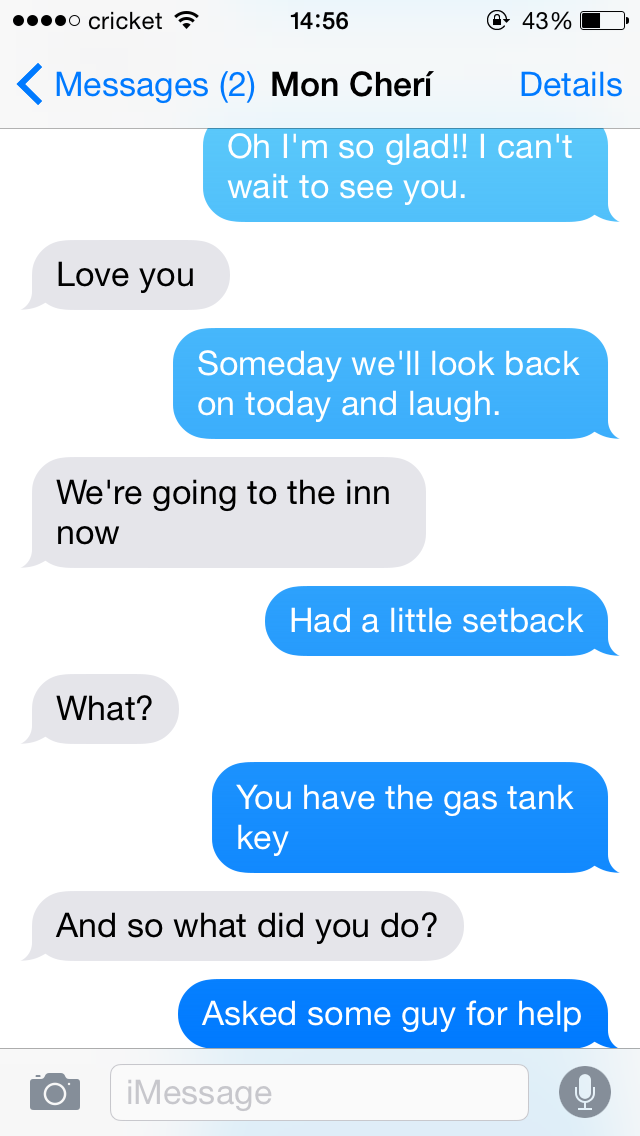
I was writing in my cubicle when he texted me.


He told me he was going to look for help, and that was the last I heard from him. I tried not to worry that he was going to wander back to a house in the woods and meet an untimely end.

He did wander back to a house in the woods, but instead of meeting his untimely end he met a wonderful mother and grown son baking Christmas cookies. The son, Jason, offered to take him to the gas station, and half an hour later he texted me again, telling me he'd made it to the rehearsal.

I'd left Chicago some time before, and was driving on the toll road a few miles west of Gary when the fuel gauge needle dipped into the orange and the dashboard started beeping at me. When I found a gas station 20 minutes later, the snowfall was thickening. 

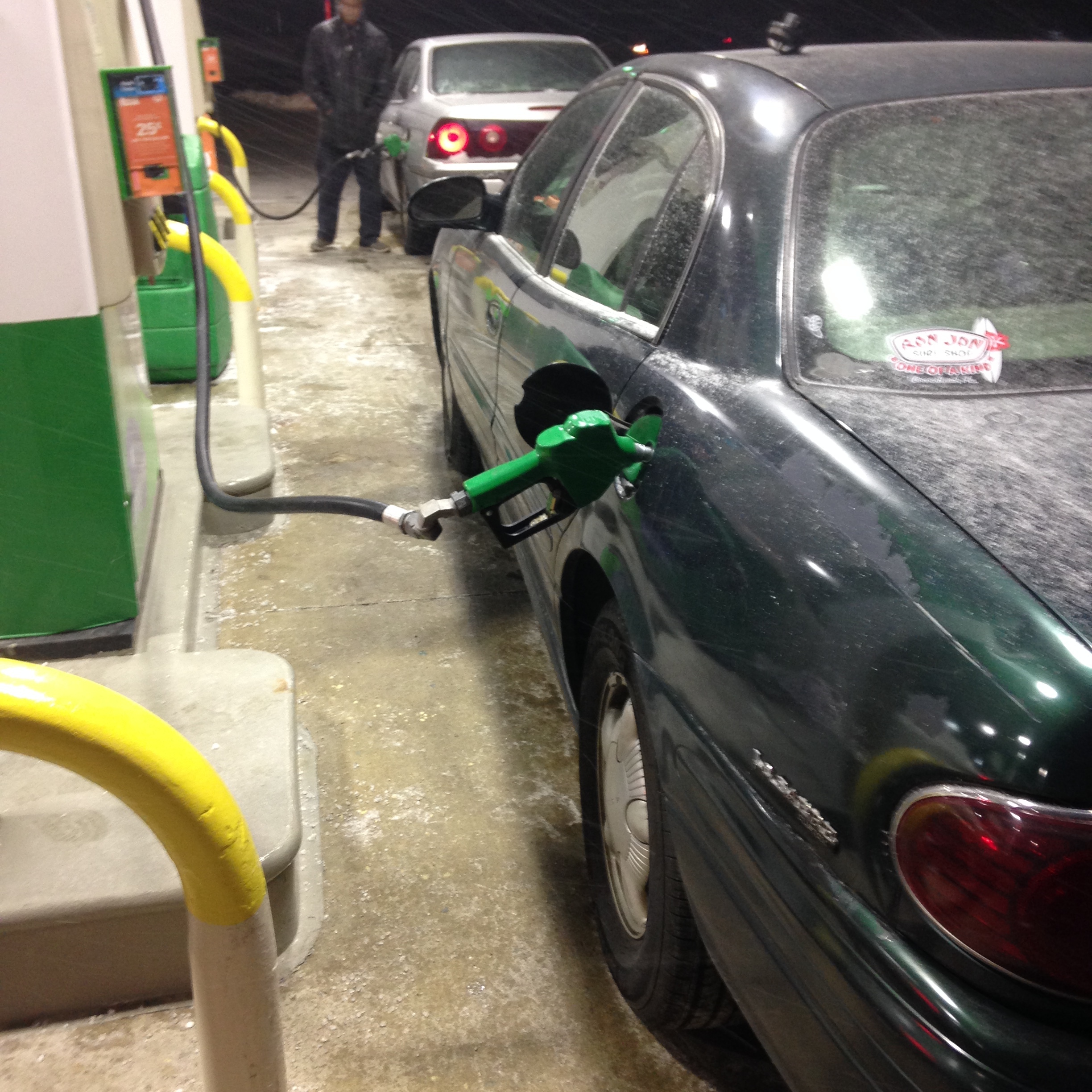
Our gas cap locks. We have a few sets of keys for our car, but the set I grabbed in my hurry out the door didn't have the key to open the cap. I tried to pry it open in the blowing snow, but couldn't, so after a little pep talk in the still-warm car, I went inside and asked a friendly looking security officer for help.

He had a skeleton key in his set of tools, and after jimmying around with the cap for a while, watching a youtube video, and rubbing his hands together to warm them up, he turned to me with a broad grin on his face, holding the gas cap.

I thanked him profusely, then filled the tank and went on my merry way, texting Curtis.
 

I believe that God puts us in circumstances for very specific reasons. I had been planning to take the train to Michigan. My bag was packed and sent with Curtis, and he was going to drive the half hour back south to pick me up after the rehearsal. I decided at the last minute to drive, which resulted in the almost-stranded experience. I spent the second half of the drive wondering why I hadn't taken the train.

Sunday night, as we were driving home from the children's Christmas program at church, the brakes on our car turned very soft (If you've ever experienced this, you understand. You press the brake, and it keeps going down, and the car doesn't stop, and your foot goes so far down you feel like you're about to kick the engine, and still nothing happens.). Our stops took progressively longer as Curtis carefully navigated his way the last two miles home. By the time we got there it took almost an entire block to stop, even with the pedal pressed all the way down.

I have now realized why I didn't take the train to Michigan.

I use our car more than Curtis does in the city, mostly to go grocery shopping. If the car was on its last leg and I hadn't driven to Michigan, the brakes likely would have gone out while I was driving around the city, buying groceries at night after work, in the middle of the winter.

I like driving, but I have no love for driving a car that doesn't stop when I press the brake pedal. Curtis, on the other hand, was fine with it. Manly challenges are good for men.

Life is often not easy (The Day There Was(n't) a Fire), but God is kind. He directs our steps and decisions, to keep us safe. He cares about making the little things a little simpler. He loves us.

The more I dust for them, the more I notice sovereign fingerprints covering my life.

Better, Not Wrong

Yesterday for the first time in a few years (it's embarrassing, I know), I went to the dentist. I grew up getting my teeth cleaned routinely, enduring the shame of continual lectures about better flossing and brushing. As it had been a several year long hiatus since the last time I went, I expected the lecture to be prolonged (although I do brush my teeth regularly, and I even floss sometimes).

Instead of a lecture, they brought me back to the inner sanctum of cleaning rooms and gray chairs (which, incidentally, have always held a certain sort of awe for me), and treated me like an honored guest.

No one lectured me about my teeth.

No one told me I was doing anything wrong.

No one chastised me for being irresponsible or lazy in regards to my mouth.

Instead, the kind dental hygienist who cleaned my teeth told me they were nice, that they looked good, and to make sure I paid attention to the gums around my molars.

She showed me into another room to wait for the dentist, and there another woman offered me a bottle of ice cold water.

I met the Dentist (even though 'dentist' is a common noun, he was tall and had a red beard and red hair and shook my hand like a lumberjack would—he deserves an uppercase.), who showed me x-rays of my teeth and said they looked great. He asked me how my experience had been and if there was anything he could do for me, and promised to give a gift card to the person who had recommended me. He looked me in the eye, told me exactly what he was doing while he examined my mouth, and answered every question I asked quickly but clearly.

As I was leaving, the young ladies working the front desk were kind and cheerful, chatty but noncommittal. There was even a huge bowl (we're talking the circumference of a medium or large pizza from Papa Johns) filled with sticks of Orbit gum on the front desk, and there was coffee by the door.

I walked out, and to my surprise realized I wouldn't mind going back (which is good, because while I was there they scheduled my appointment for June. Who knows where I'll be in life in 6 months... But at least I'll have a sparkling smile.).

I used to spend days dreading the dentist; but not because I had bad teeth or lots of cavities or didn't like the taste of fluoride (although it's not my favorite). It wasn't for any reason besides that it was unpleasant, and I always got lectured or scolded or told I wasn't "taking good enough care of your mouth," and "teeth don't grow back when you mistreat them." I remember wincing in pain as the hygienist nicked my tender little gums with her tools, and I can still see the blurry ceiling through my teary eyes as I bore what felt like a dozen metal instruments in my mouth, all pricking and poking and jabbing. 

While my memories may be exaggerated by my youthful distate for the whole experience, I still carried some dentist-fear deep in my heart.

Until yesterday. 

I spent a lot of time thinking this week about how I like to be "handled," so to speak. Not physically, but in relation to my skills and talents and responsibilities, as a student. If every person is unique, each person has a different way they like to be taught. Most schools use the simple teacher/student method, because even if it's not the best for everyone, it's the most effective method to mass produce education.

In this method, teachers don't have a lot of time to devote to individuals, but often when they do it's for blunt correction and hasty set-straights.

In such cases as math and science and driving a car and playing the piano, perfect practice makes perfect. Letting someone practice wrong is doing nothing for anyone.

But in creative exercises, like writing and painting and photography and making pretty things, it's a more detrimental style of teaching. Bluntly telling someone that they've done badly at creating is as good as telling them not to try again.

In creating, I want to be told how to do better, not what I'm doing wrong.

Maybe it (the painting, the picture, the poem) is awful, not fit for human sight or consumption. But rather than a straight knock-over gale force wind, there's always room for the gentle breeze. 

Anne Lamott, in Bird by Bird, wrote, 

You don’t always have to chop with the sword of truth. You can point with it too.

Yes, if I'm making an egregious error, I do need to be told. Please don't let me drive off a cliff because you don't want to tell me I'm holding the steering wheel wrong.

But if my work needs whittling and reform, plain and simple editing, I want you to tell me what makes a good writer and give me time to try again. And maybe fail again, but to keep trying until I've succeeded. It might take a little longer, but in the long run I'll own the lesson and the skill.

It's harder for the student, because it takes more work, frustration, and determination. It's harder for the teacher, because if you know something it's extremely difficult to hold your tongue.

But in the long run, the lessons that are worth learning are the ones you had to work for.

Like writing well, or being a better ball player. Or brushing your teeth.

PS. You should definitely ALWAYS brush your teeth. It is not a creative exercise—it is your only mouth. I am telling you to.

You Must Learn to Rise Above

The Wall Street Journal publishes a magazine for their subscribers every other month. In general, it is full of advertisements for expensive luxuries, and moody articles about different things. However, the written word still prevails, and in each edition, there is a Soapbox feature, a page where six people get to weigh in on one single topic, chosen for them by the editors. The topics vary from tangible to conceptual; the most recent issue covered Manners.

Laura Dern is an actress in The Founder, a film coming out in January, and in Big Little Lies, a miniseries airing on HBO in February. She wrote a particularly insightful blurb, saying,

"It's always thrilling when I meet people, particularly men, whose manners are beautiful. My earliest education in manners came from my Southern Grandmother and Southern mother.

I was raised to believe that a man opened the door for a lady; he walked down the stairs in front of her so that should she trip and fall he could catch her.

A properly raised gentleman considered how he could support a woman, not because she's more delicate, but because it was the right thing to do. So the presidential election has been a true education for me and for my daughter as well.

The most offensive quality is the quality of a bully. My grandmother taught me that even when you're angry, you must treat others with respect. You must learn how to rise above."

Even when someone is trying to pick a fight, even when no one is looking, you must learn how to rise above. 

It is a building block of character, and the ability to do so will be invaluable for the rest of your life.

Settling for Second Best

Yesterday was our work Christmas party. It was happy, successful, and red and green. There was also a cookie decorating contest.

We had 30 minutes and two cookies, and in classic creative nature, I spent 25 minutes on one cookie and 5 on the other.

The first was the passion of my heart, the brilliant idea borne of the several minutes of planning allowed to us before the decorating began. I planned out materials, shapes, colors, sizes.

The second cookie I threw together (by which I mean decorated) at the last minute after I realized I was the only person who thought my first cookie, my pet project, was beautiful. Even I am not entirely oblivious.

For your sake, pictures.

I'll let you decide which was my pet project, but let me give you a hint: I love snow and trees and cabins and little stone paths and clear cold wintery days, and I'd rather draw a picture and a story than "ketchup on bologna" (pardon the unappetizing analogy).

The table unanimously decided that I should submit the ornament, so I did. And won second place. Which was cool. But that's not the point.

I liked winning. Winning is fun. Games are more fun when you win (But be a good sport still, because even if you don't win they're still fun. I know, because I lose board games all the time and I still enjoy them.), everybody likes to watch football better when their team is winning, and in movies we always route for our favorite teams to achieve victory.

But I didn't submit the cookie that I loved, I submitted the cookie that would look better to everyone else.

Pardon the philosophical grasp for meaning in a cookie decorating contest.

Most people who create things know what it's like to love what you make. You think of a unique idea, work on it, put it together, spruce up the details, and pour love into it. Then you polish it up and introduce it to the world, and everyone raises their eyebrows because it's different from what they're accustomed to.

So you put together something that people are used to seeing, and you make it pretty but it's not your heart, and you make it walk the plank into the great peopled abyss. And it doesn't reach the water because people are so excited about it and they snatch it up before it has a chance to touch the salty drip.

But in your heart, you really still love the one you loved first, the one you poured your heart into, the one that was your best idea.

The cookie analogy loses some traction here, because I didn't care this deeply about my cookies. I just thought about it a lot.

Writers (and all creatives) sometimes have to pause their pet projects, their grand ideas, to work on something that will work for them, something that the public will love, something that will put dinner on the table and shoes on the feet. It's easy in those times to forget the first best idea. It's easy to settle into complacency because you've discovered what people love, and you can do it well, even though you don't love it too.

But at the end of the day, even after you've given the public what they want, and made something that people will love, don't forget to do what you love.

Choose something, work hard on it, and make it great. Don't settle for second best.

The Day There Was(n't) a Fire

Last Tuesday I was getting ready to leave work for lunch when I got some unexpected texts from Curtis.


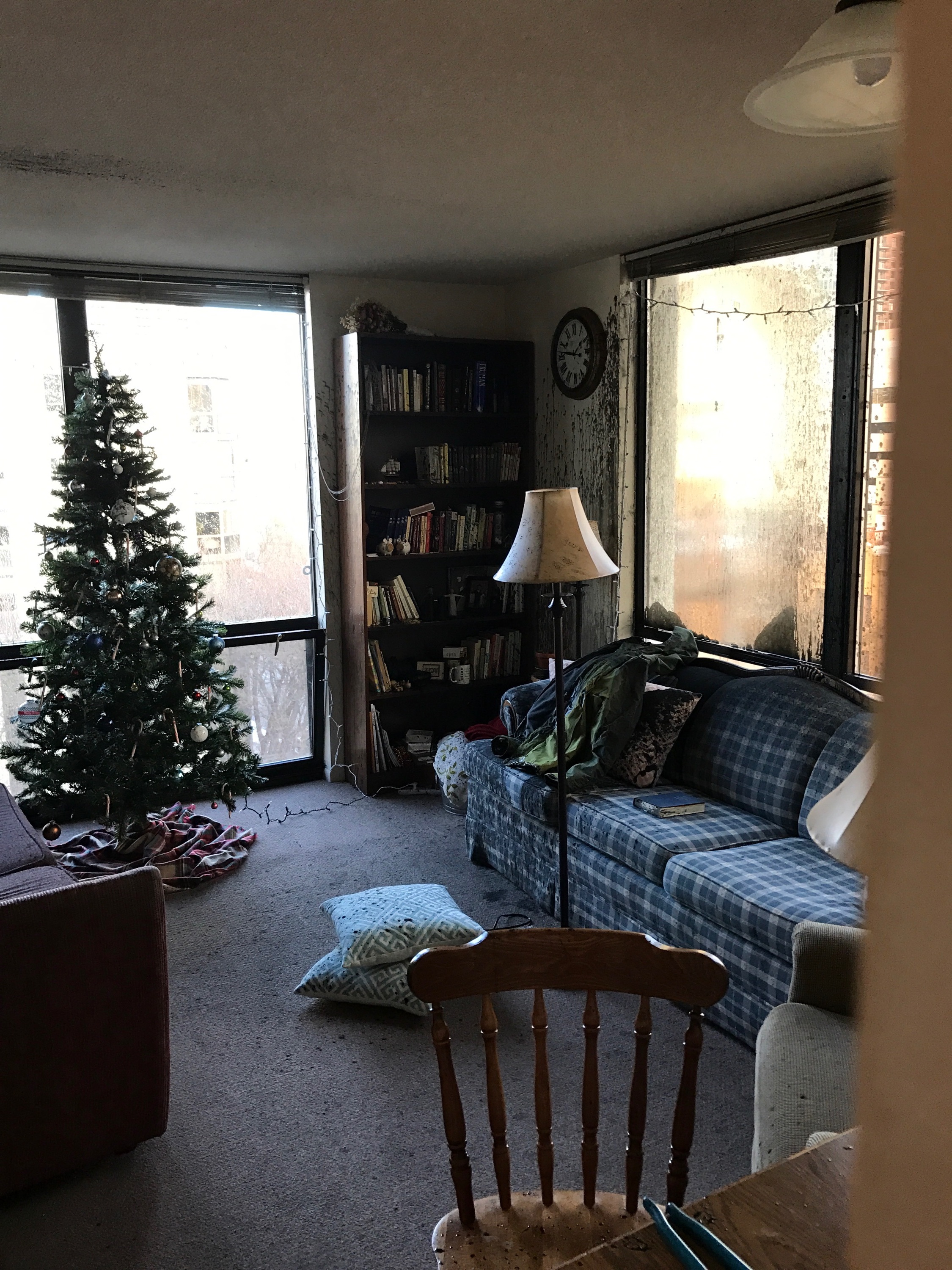
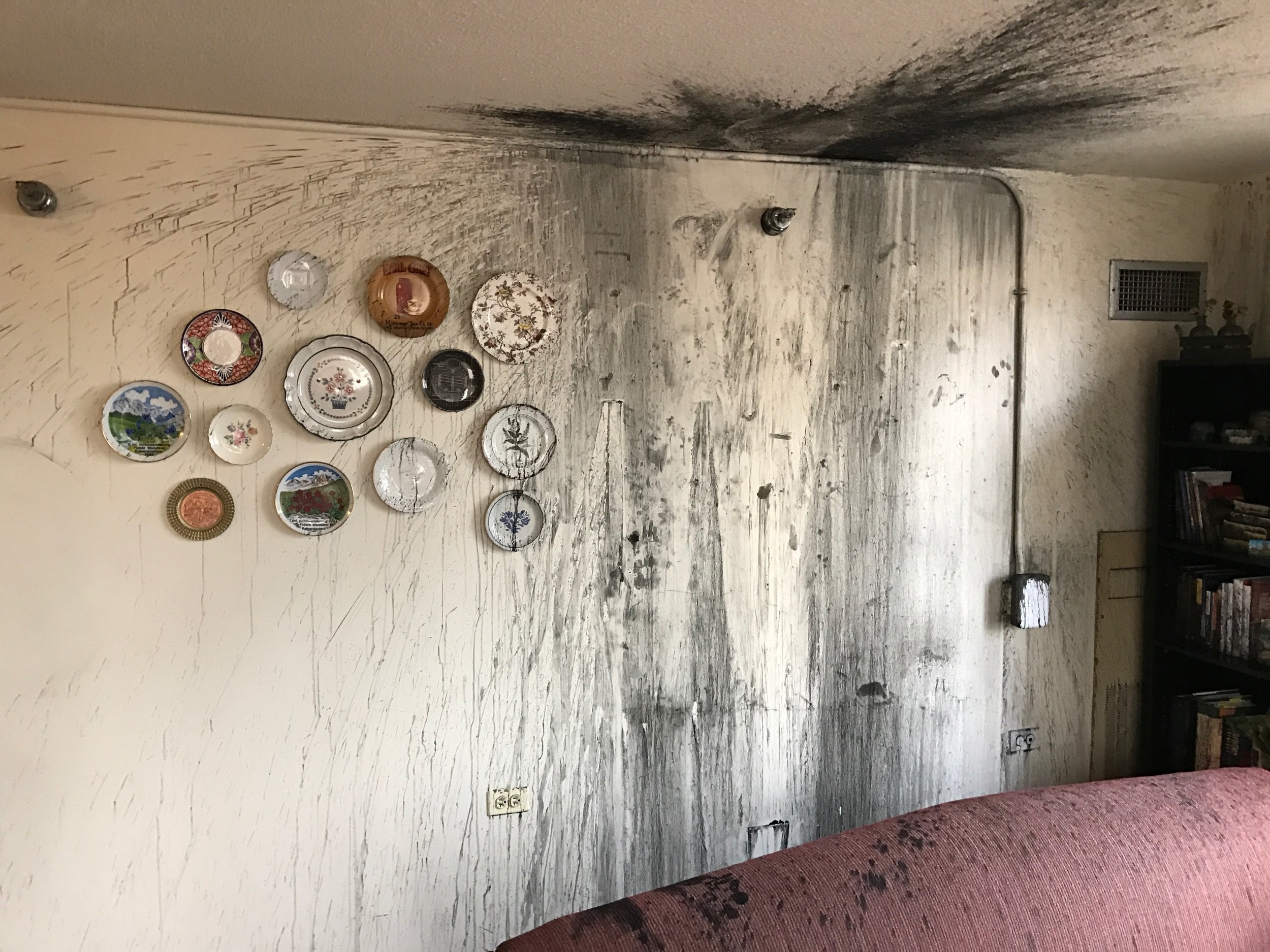
I smelled it in the hallway before I saw our wet living room. The picture doesn't capture the water that was spitting at the ceiling, streaming down the wall, and soaking the couch and carpet.

Really, it was fine because it was just water, and nothing was hurt besides the couch. We ate lunch as usual, while the plumber scurried in and out and waited for the water to completely drain the our system so he could take the head off and fix the problem. I went back to work confident that when I got home that night, everything would be cleaned and airing out.

Ten minutes after I got back to work, I got more texts. This time they were from my brother, who we asked to sit in our apartment for the afternoon.

Do you want a video of the bad news?

I expected a quick clip of a hole in the wall they'd had to break to turn off the sprinkler. What I received instead stopped my heart. 

The water wasn't completely off, and in some mis-chance, when the sprinkler head came off, it fire-hosed greasy black water all over our living room. What the night before had been a cozy, christmas-y nest was turned into a dank smelly black wet mess. We spent the rest of the afternoon in limbo, as I tried to figure out what we needed to do while I was at work, and Curtis worked to assess the damage and see what could be salvaged.

When I got home from work and walked into our apartment building, a group of facilities workers got off the elevator in the lobby. They were covered in black and smelled awful.

I asked them if they came from the corner apartment on 8 and they nodded and said,

We’re so sorry.

Usually when people see our apartment, they say, "It's so cute," and "We love how you decorated," and "your couches are so comfortable." They don't apologize.

The elevator smelled faintly, and the closer I got to the apartment, the worse it smelled. Nothing could have prepared me for walking into my tiny cozy home and finding it wet, black, smelly, steamy, a stained shell full of ruined belongings.

I felt like a kid who's trying to learn to ride a bike and keeps falling over—the weight of discouragement was so heavy I wanted to sit down on the floor and cry. But I couldn't, because the floor was covered in black greasy water and the couches were filthy.

Apparently, after water sits idly in clean pipes and extracts sediment from said pipes, sprinkler water turns black. The translation of that into simple language is that the movies have been lying to us all this time. In The Office (spoiler alert) when Michael Scott proposes and all those smiling people get drenched with clear water from the sprinklers, it's an inaccurate depiction (of course, covering everyone with smelly black water probably wouldn't have had the same effect. For the sake of the story, media, deceive on.).

Just know for your own benefit:

Sprinkler system water isn't crystal clear.

After everyone who had been cleaning left, we sat on stools in our living room and just stared. For a long time.

We bemoaned the ruined Christmas tree that we'd put up three days before, the sodden couches, and the cozy blankets (now covered in nastiness) that we wrapped ourselves in so many times to watch movies and eat homemade pizza on Friday nights. Our books had been straight in the line of fire (ha), and they were all ruined.

My parents brought dinner (and some parental care, concern, and encouragement), and when they left we picked the blackened ornaments off the tree in silence, hoping maybe they were salvageable. 

Then we made a list of everything else that got ruined in "The Black Drench." It felt far too long. Without my brother and his wife and the Oreos they brought over, we probably would've given up. Even with them it took a few hours to write down everything we'd lost and what we guessed it would cost.

The next 72 hours were a roller coaster of talking to person after person about what had happened, and what was next, and where we were going to sleep that night. We never implemented my grand plan of cardboard boxes under a bridge, even though a few afternoons I thought we might have to.

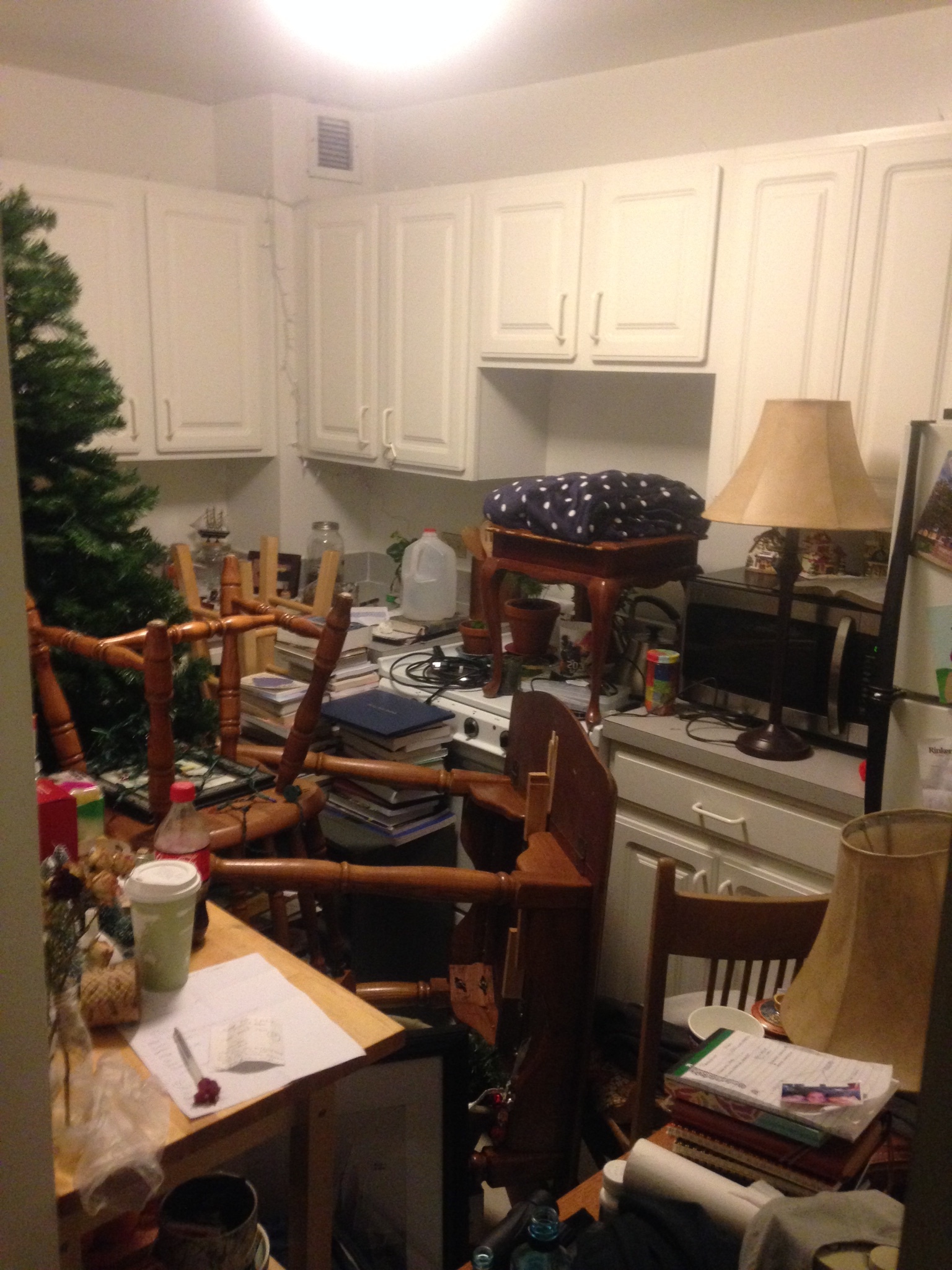
Two days later, they knocked out part of the wall, took out the carpet, and started some serious deep cleaning. At one point, all of our saved furniture (and the tree, which has since met its demise) besides our bed and dressers fit in the kitchen.

There were crews working on our apartment tirelessly, from morning to night, all week. Men came in and painted, laid carpet, and scrubbed the ceiling and walls, even on Saturday, so we could move back in as soon as possible.

Everyone was kind, everyone worked so hard for us, everyone did their best to make sure that we'd have a clean happy home to move back into. 

Yesterday, 7 days after the original fiasco, we got to move back into the apartment. It's freshly painted, newly carpeted, and squeaky clean. We don't have any living room furniture, but we have a living room. And that alone is a privilege. 

I learned some stuff in the past week.

What matters lasts.

I used to think that it was important to have things; things mean stability, comfort, establishment. You need couches to sit on, books to read, and a Christmas tree to celebrate Christ's birth. I don't at all discount any of those things, but in the past week I realized I'd much rather have Curtis and none of the other things, than have all the things and not Curtis.

People can sit on the floor, libraries have plenty of books, and Jesus Christ coming to earth is much more significant than just a shiny Christmas tree in my living room (don't get me wrong, I do love Christmas decorations).

At the end of the day the things that matter are still there: love, Jesus, family, friends. The accessories may change the experience, but they don't change the truth.

People are kind.

As a glass-half-full person (but let's be real, if it's chocolate milk, it's half empty. There's no such thing as enough chocolate milk.), I usually see the good in people quicker than the bad. I'm not naively oblivious, but a lot of people do a lot of good that goes un-commended, and I try to look for it.

In the past week people have been nothing but kind. We've been given gift cards for food, money, small kind things like cups of coffee, and other little gifts that might seem like nothing to the giver, but they felt like everything to us.

Dozens of people have worked together to keep us optimistic, to clean our house, and to simply care. Their consideration has gone above and beyond the call of service provider and worker, and reached a level of kindness that would give even the staunchest pessimist a fragment of hope. 

Maybe we need disasters more often, if this is what it brings out in people (disclaimer: I am not wishing exploded sprinkler heads on any of my friends or neighbors.).

I am not enough, but...

My natural instinct is that with enough grunting and legwork, I can get things done. Many times, that is true; hard work builds bridges and climbs the un-scaleable wall. 

In this case, it most certainly was not. Feeling powerless-ness is debilitating to a do-er, and standing in my trashed living room, helpless to clean or move things or repair everything broken, I felt entirely insufficient. Not because there was nothing I could do, but because I couldn't do enough. I couldn't fix it, I certainly couldn't make it all better, I was incapable of doing the things that badly needed to be done. Almost everything happened without my instruction and without my help. I did a lot of work, but at the same time, I barely lifted a finger.

It was an important jolt to my self-sufficient mentality. Surrender and dependence don't come naturally to me, but experiencing forced surrender and helpless dependence reminded me that I am not enough. I never will be. But Christ in me is enough. He is the beginning of every good thing that comes from me, and the completion of every keen idea that spreads through me.

I am not enough. But Christ is. 

I learned a lot of other small things, but those three are the ones that I'm setting out to remember, the ones I'm writing down to articulate clearly, and the ones I'll tell my kids about when they're old enough to understand what a trashed apartment and no renters insurance means.

May you never have to learn these things in the same way I did.

Love,
Anneliese, happily no longer homeless.

Writing Through Hard Stuff

It's good to write about some things while they're fresh—the pain of the breakup, the excitement of an unexpected gift, and the solemnity of loneliness. 

Other things take some time to process and mull over, before you can form anything edifying.

The quick writes are the pieces that help a writer's constitution. It's like being a short order chef; going quickly from one thing to the next keeps the brain stays oiled and the fingers spry. 

The things that take more consideration clog the mind, because even though you're trying to write, your mind isn't in it. It's like trying to write through writers block, only worse because you don't even care a little bit about what you're saying. You want to sigh and give up and cry, because everything you've ever tried is just NOT WORKING.

And maybe sometimes you do, because writing is impossible. Then it's sweat pants, ice cream, trusty spoon, and Hallmark movies till spring comes again.

Because after all, maybe no one even cares if you write or not.

But there are bursts of inspiration and thunderclaps of conviction, because, after all, you are a writer. It's what you were born for, it's what you love, it's what you do best. It doesn't matter if people care or not, because you don't write for them. You write because without writing, you aren't you. Without writing, you don't think, process, and express. Without writing, there's a void in your soul.

That's why, even when you can't afford to share any brain space with the little things, you write anyways. Even if you're writing about bubble gum, grass clippings, and getting dirt in your eyes, you write anyways.

It's what makes you a writer.

Havoc

This cartoon is a pretty accurate depiction of the past 24 hours of our existence, minus the whole dinosaur/dragon stomping through the city thing.

There was a bit of a debacle with the sprinkler head in our apartment—I'll be publishing a story about it soon.


In the meantime, we're embracing the abundance of God's protection over all we really hold near and dear.

Why It's Important to Write

There are a few reasons that I get writers block. 

First is the completely elusive cause that no one understands, the sudden disappearance of all sensible content from the conscious mind. One moment there are dozens of thoughts and ideas scurrying around your mind—the next they've vanished, leaving no remnant.

Second is the world of distractions. Writing in my house means that the house needs to be clean and neat (dishes washed, clothes folded, and table cleared of papers and clutter), otherwise it's a constant battle between my desire for a clean space and my will to write. Writing in a public space means that there are dozens of people for me to observe, and my mind would always rather wander than work.

The third is like the rusted hinge, the scuff free shoes, the ten year old car with 2,000 miles. It's hard to do anything cold turkey—diet, exercise, sing, and write. I write every day, partially because I love it but also because if I don't, when I come back to the keyboard all that greets me is a blank screen and the crickets. And the crickets. And the crickets.

I'm learning to write with dogged persistence. Sometimes it's tiring, often it's hard, but it's consistently rewarding.